THE ARC DE TRIOMPHE: HISTORY, SYMBOLS AND VIEWS OVER PARIS
Categories : Parisian life, published on : 9/21/26
Just a few steps from Rue Vernet, the Arc de Triomphe stands as one of the most prominent landmarks on the Paris skyline. Both a historic monument and a remarkable viewing platform, it reveals another side of the capital to visitors who take the time to observe it, explore its sculpted details and climb to its rooftop terrace.
From its construction in the early 19th century to the symbols carved into its stone, from the Memorial Flame to the sweeping perspectives over Paris’s grand avenues, this guide offers a different way to discover the Arc de Triomphe and fully appreciate one of the finest views in the city.
Key information :
Address: Place Charles-de-Gaulle, 75008 Paris
From Hôtel Vernet: approximately 300 metres, or a 4- to 5-minute walk
Access: via the Passage du Souvenir, without crossing the traffic circle
Climb: 284 steps
Ideal for: couples, families and photographers
A MONUMENT
born of the Empire
From Napoleon’s Commission to the 1836 Inauguration
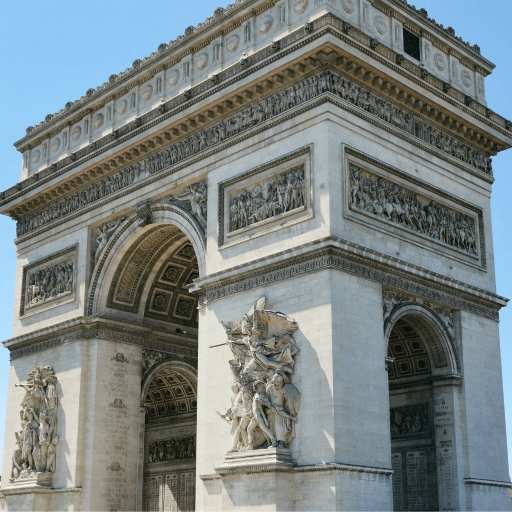
Napoleon I commissioned the Arc de Triomphe in 1806 to celebrate the French armies. Architects Jean-François-Thérèse Chalgrin and Jean-Arnaud Raymond designed a single-arched monument inspired by the triumphal arches of antiquity. Construction continued through several political regimes, interruptions and changes in dedication. The monument was finally inaugurated on July 29, 1836, thirty years after work began.
This long history explains the richness of its decoration. The names of battles and generals engraved in the stone make the monument an archive of the French Revolution and the Empire. Standing approximately 50 metres high, it overlooks a square from which twelve avenues radiate. From the terrace, this geometry visually connects the Champs-Élysées, historic Paris and the modern western districts of the capital.
SCULPTURES TO BE READ
like a history book
The Departure of the Volunteers
On the northeastern pillar, François Rude depicts the departure of the volunteers in 1792. Often known as La Marseillaise, the composition is dominated by a winged female figure, an allegory of Liberty, calling the people to battle. The tense bodies and diagonal lines give the relief a powerful theatrical energy.
Triumph, Resistance and Peace
Facing the Champs-Élysées, Jean-Pierre Cortot’s The Triumph of Napoleon celebrates the year 1810. Antoine Etex’s two sculptural groups, Resistance and Peace, portray two opposing conditions of the nation: defending its territory, then returning to work, family life and prosperity. Walking around the monument before climbing to the terrace provides an opportunity to compare these four narratives.
Ideal for:
- A cultural visit before a day of shopping
- A family activity combining history, sculpture and panoramic views
- An architectural walk towards Avenue Marceau and the Golden Triangle
BENEATH THE ARCH
the memory of an unknown soldier
A National Tomb
The Unknown Soldier was brought beneath the Arc on November 11, 1920, before being permanently laid to rest there on January 28, 1921. His tomb does not commemorate a named leader, but all the soldiers who died without being identified. The former triumphal arch therefore also became a place of silence and remembrance.
The Rekindling of the Flame
First lit on November 11, 1923, the Memorial Flame is rekindled every evening at 6:30 p.m. Attending this ceremony offers an opportunity to experience a monument that remains closely connected to France’s national commemorations. Visitors should stand back and behave respectfully throughout the ceremony.

THE ROOFTOP TERRACE
Paris in four directions
Looking East and West
After climbing the 284 steps, the view follows the Champs-Élysées towards Place de la Concorde, the Tuileries Garden and the Arc de Triomphe du Carrousel. In the opposite direction, Avenue de la Grande-Armée leads towards the towers of La Défense and the Grande Arche. This direct perspective between a 19th-century stone monument and the modern business district makes the evolution of Paris clearly visible.
The Capital’s Major Landmarks
The Eiffel Tower, the dome of Les Invalides, Montparnasse, Sacré-Cœur and several other monuments rise above the rooftops. Orientation tables and a digital display help visitors identify more than twenty landmarks.
The morning generally offers a quieter view of the avenues and façades. Towards the end of the day, the Eiffel Tower becomes a glowing landmark on the skyline. As the terrace is exposed to the wind, an extra layer of clothing can be useful, even on warmer days.
Practical details:
- From April 1 to September 30: generally open until 11 p.m.
- From October 1 to March 31: generally open until 10:30 p.m.
- Last admission: 45 minutes before closing
- Individual admission: from €16 to €22, depending on the date and period
- Opening hours may change during ceremonies or in the event of adverse weather conditions
FROM THE ARC DE TRIOMPHE
to Hôtel Vernet
From the Arc de Triomphe, it takes only a few minutes to reach 25 Rue Vernet. Hôtel Vernet occupies a cut-stone building dating from 1913, reimagined by François Champsaur. Wood, brass, marble, glass, geometric lines and contemporary artworks extend the building’s post-Haussmannian architecture without turning it into a static period setting.
This approach sets the property apart from the grand traditional hotels of the Golden Triangle. Its intimate boutique scale creates a residential atmosphere, while the rooms and suites evoke contemporary Parisian apartments. At Le V restaurant, a glass roof created by Charles Champigneulle over a structure attributed to Gustave Eiffel allows natural light to fill the contemporary interior.
The hotel is equally suited to cultural stays and business trips. Wi-Fi, modular meeting rooms, a restaurant, a bar and concierge services allow guests to move easily between appointments and exploring the city. The Arc de Triomphe, the Champs-Élysées, Avenue George-V and Avenue Montaigne are all within walking distance of Rue Vernet, making the hotel an ideal starting point for discovering the Golden Triangle.
FAQ
How far is Hôtel Vernet from the Arc de Triomphe?
Hôtel Vernet is located at 25 Rue Vernet, approximately 300 metres from the Arc de Triomphe. It takes around four to five minutes to walk to the Passage du Souvenir, which provides access to the monument.
What is the best time to visit the top of the Arc de Triomphe?
Early morning is ideal for visitors looking for a generally quieter terrace and clear views over the avenues. The end of the day is recommended for watching the sunset, experiencing the blue hour and seeing Paris gradually light up. Opening hours and potential closures should always be checked before visiting.
Is Hôtel Vernet a design hotel?
Yes. Hôtel Vernet combines a post-Haussmannian cut-stone building dating from 1913 with a contemporary renovation led by François Champsaur. Its interior features wood, brass, glass, marble, geometrically designed furniture and contemporary artworks.
What sets Hôtel Vernet apart from other hotels near the Champs-Élysées?
Hôtel Vernet stands out for its intimate boutique-hotel scale, personalised welcome, Parisian residential atmosphere and the dialogue between its historic architecture and contemporary design. Its glass roof, created by Charles Champigneulle over a structure attributed to Gustave Eiffel, is also one of the property’s most significant heritage features.
Is Hôtel Vernet suitable for business trips, shopping and evenings out?
The hotel offers Wi-Fi and modular rooms designed for meetings and professional events. Its Le V restaurant, bar and concierge service allow guests to continue their day without leaving the property. The Champs-Élysées, Avenue George-V and Avenue Montaigne are all within walking distance for shopping, appointments and evenings out in the Golden Triangle.